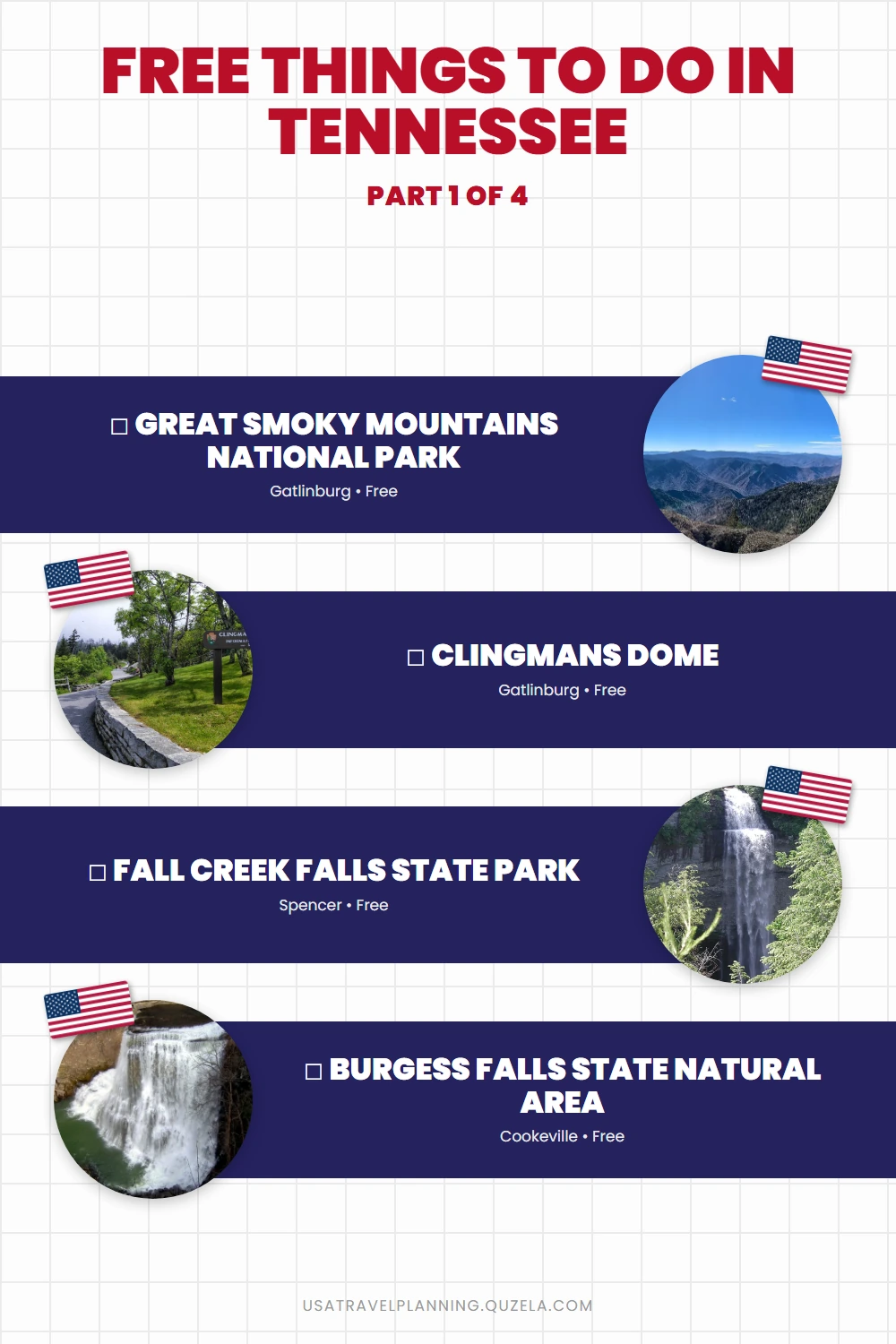
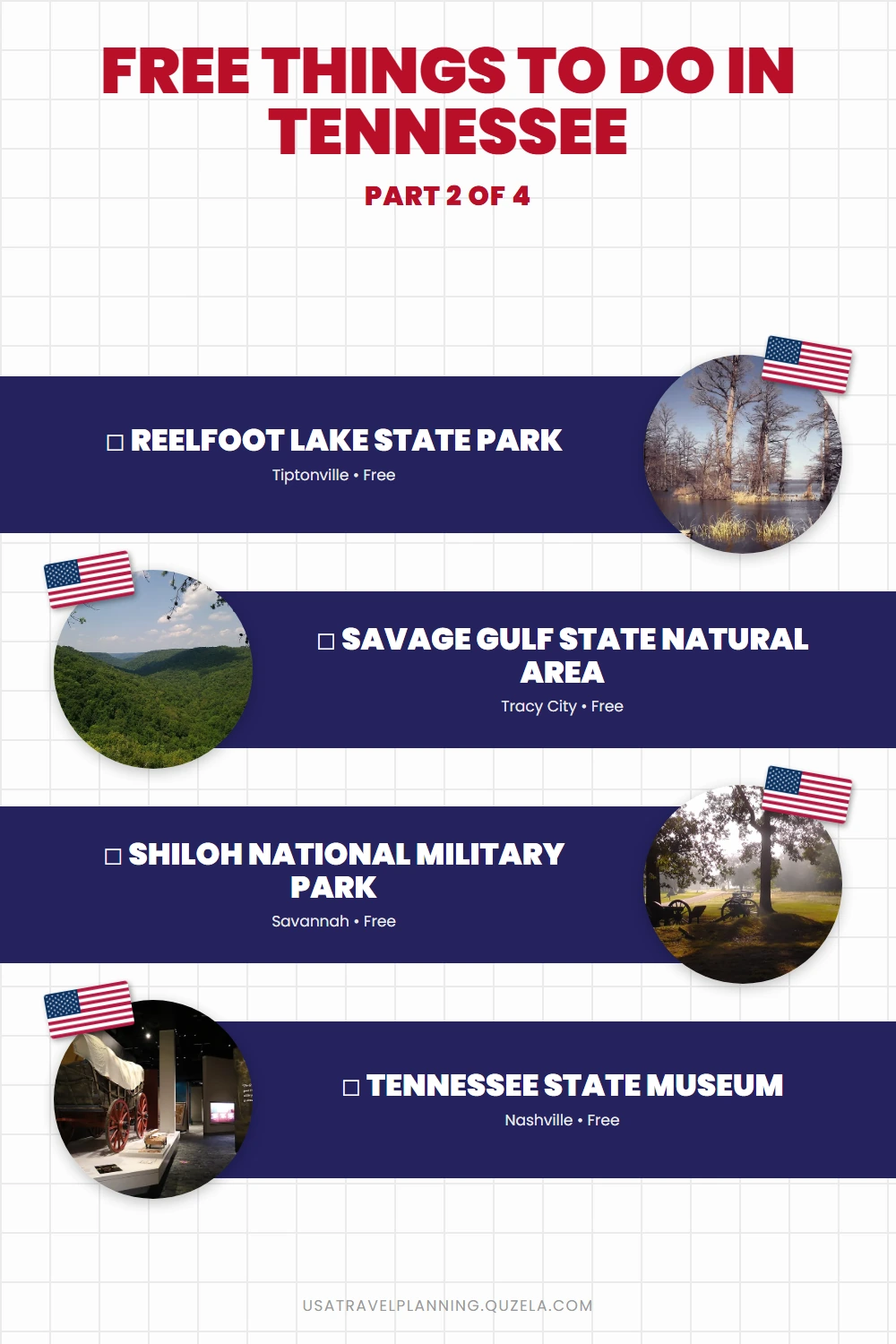
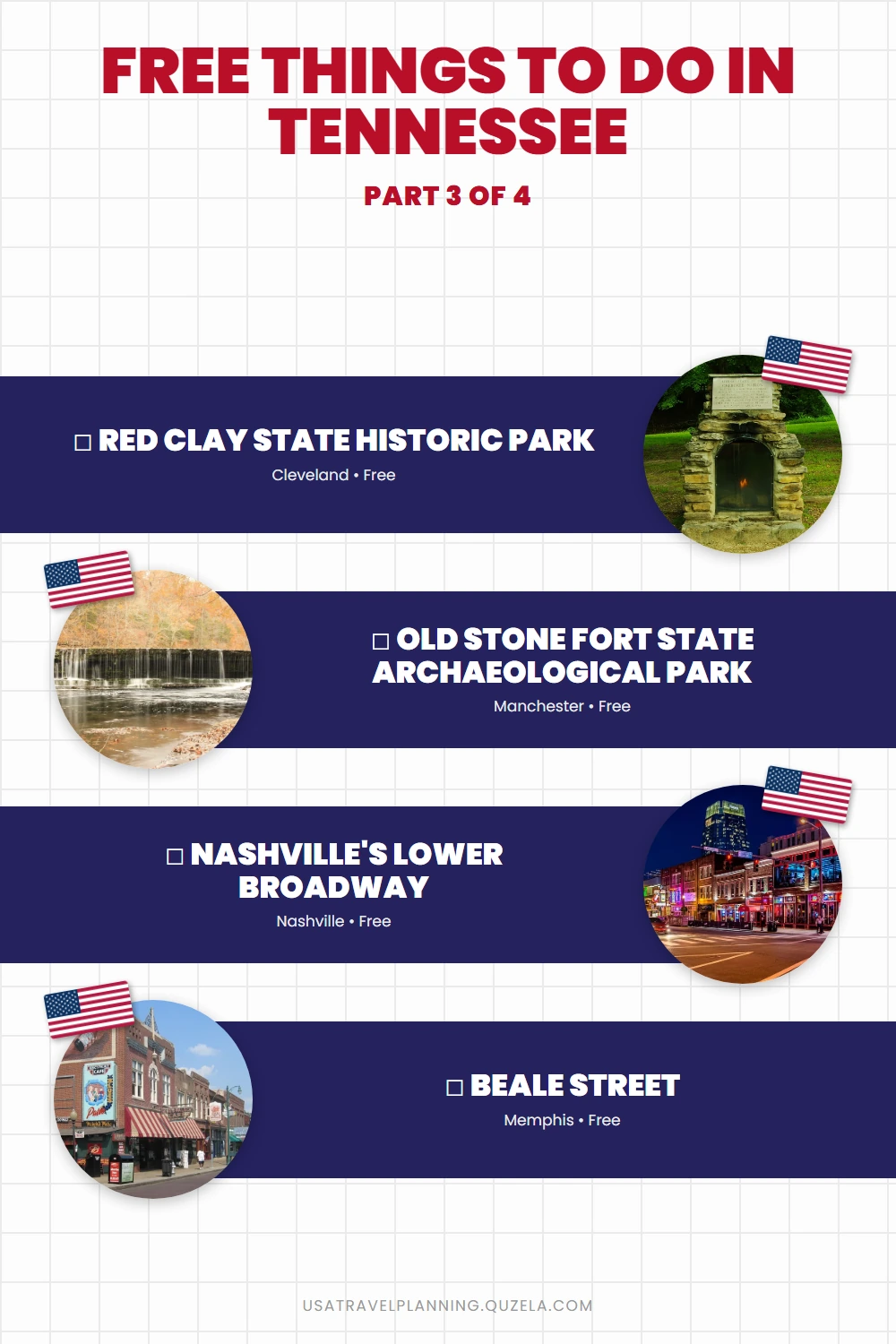
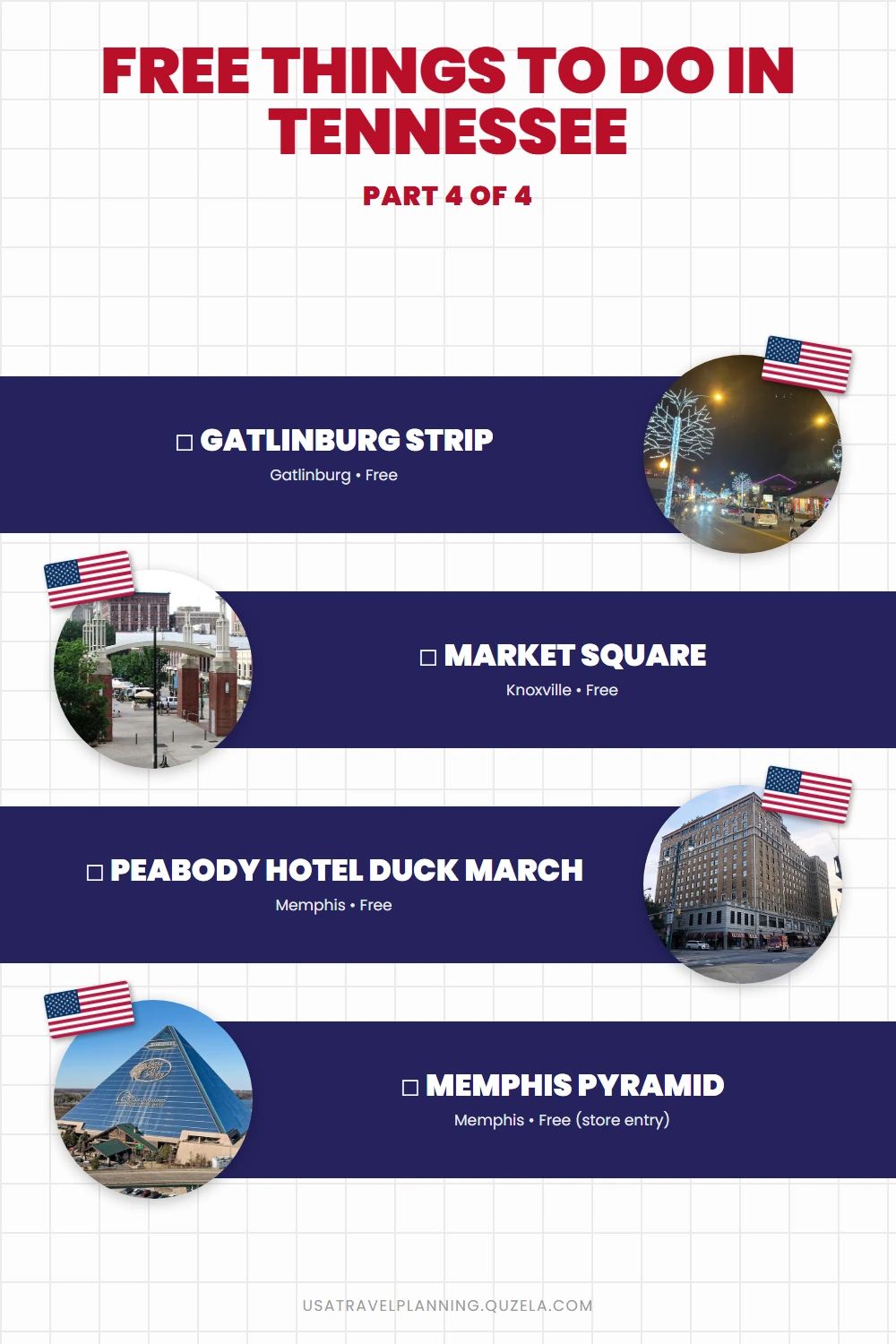
Tennessee has more free attractions per state mile than most visitors expect — a national park with no entrance fee, a Civil War battlefield covering 3,600 acres of open land, a 60,000-square-foot state history museum in Nashville, and two entertainment districts where live music runs from noon to midnight at no charge.
The 17 picks below are genuinely free: no admission, no required reservation fee, no minimum spend. A handful (like the Peabody Hotel duck march) have free experiences within a larger commercial setting.
16 destinations selected from a curated US travel dataset — prioritized by regional distribution, visitor significance, and independent research. Must-see and Worth-the-detour ratings reflect relative value within Tennessee.
Jump to: Parks & Waterfalls · History · City Walks · Free Tennessee Originals · Planning Notes
Parks & Waterfalls
Tennessee's park system is exceptional — from the country's most-visited national park to state natural areas protecting gorges, waterfalls, and cypress swamps that most visitors never reach.
Great Smoky Mountains National Park Must-see
Sevier County · Gatlinburg
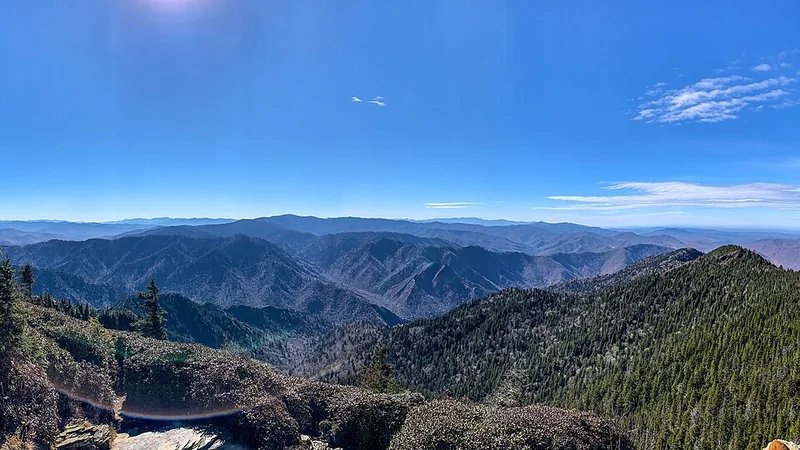
The most-visited national park in the United States — 13 million visits in 2023 — and one of the only major national parks without an entrance fee. The park covers 522,427 acres across Tennessee and North Carolina, with elevations from 875 to 6,643 feet and the largest old-growth hardwood forest east of the Mississippi. Spring brings 1,500 species of flowering plants; fall brings the most dramatic foliage display in eastern North America. Parking reservations are required at popular trailheads from May through October ($2 per reservation via recreation.gov). The Roaring Fork Motor Nature Trail and Alum Cave Trail are the two best free-day options from the Gatlinburg entrance.
Watch on YouTube · View on Google Maps
Clingmans Dome Must-see
Sevier County · Gatlinburg
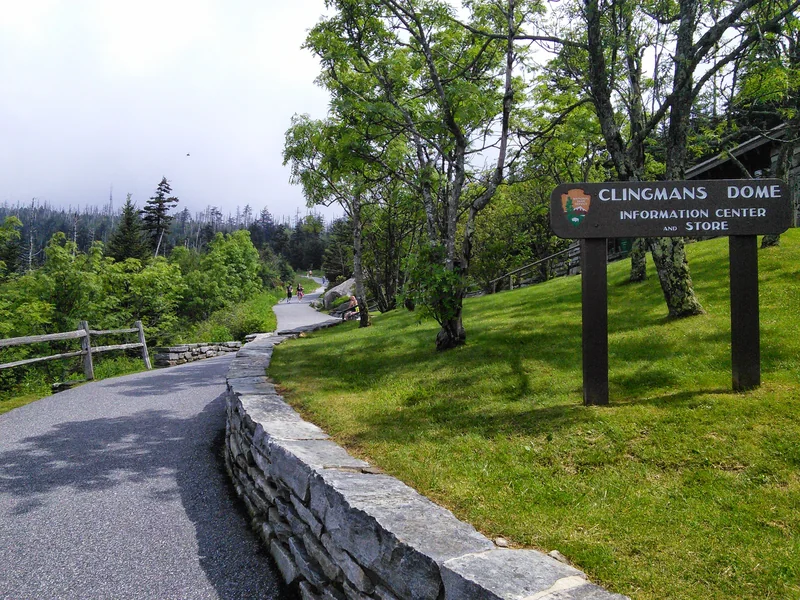
The highest point in the Smokies at 6,643 feet and the highest point on the Appalachian Trail. Clingmans Dome Road climbs 7 miles from Newfound Gap to a parking area; a paved half-mile trail gains 330 feet to a concrete observation tower with 360-degree views extending 100 miles on clear days. No additional fee within the park. The road closes December through March; arrive before 10 AM on summer days to find parking.
Watch on YouTube · View on Google Maps
Fall Creek Falls State Park Must-see
Van Buren County · Spencer
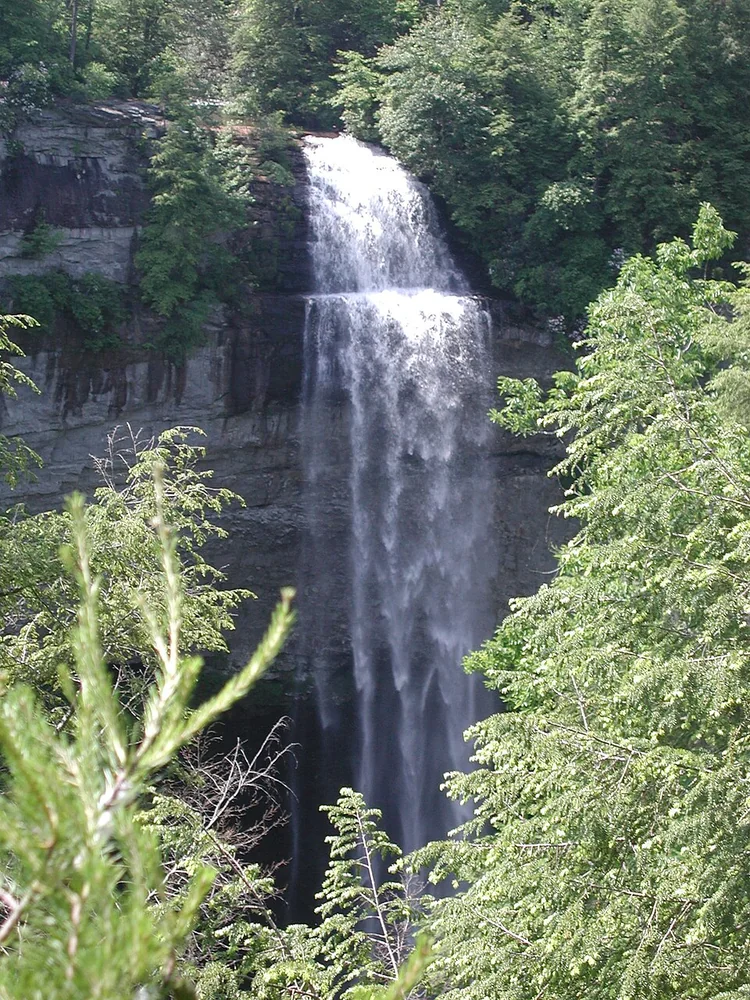
Fall Creek Falls is a 256-foot plunge waterfall in Van Buren County — the tallest free-falling waterfall east of the Mississippi River. The state park covers 26,000 acres with additional falls (Cane Creek Falls at 85 feet, Piney Falls at 95 feet), a swimming beach, and 34 miles of hiking trails. Gorge overlooks are a 5-minute walk from the parking area; the descent to the base of Fall Creek Falls takes 20–30 minutes on a maintained trail. No admission fee; the park is open year-round.
Watch on YouTube · View on Google Maps
Burgess Falls State Natural Area Must-see
Putnam County · Cookeville
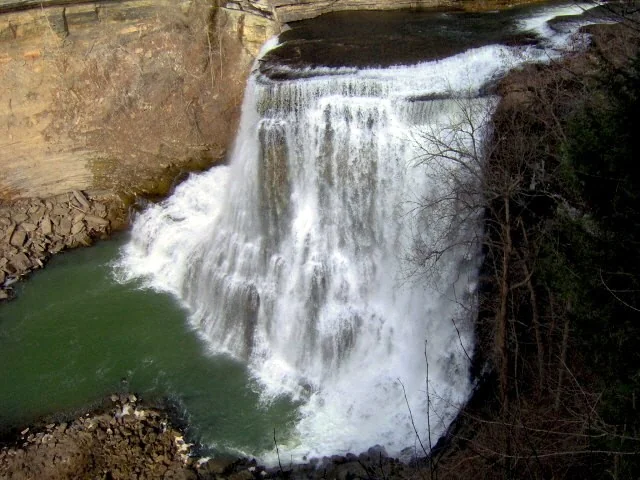
Burgess Falls is a series of four waterfalls on the Falling Water River, ending in a 136-foot main plunge into a swimming hole. The trail (1.5 miles one way, moderate difficulty) passes all four falls in sequence — the first two are easily reached, the third drops 30 feet into a pool, and the fourth is the dramatic main fall. No admission fee; the trailhead is 8 miles south of Cookeville. The swimming hole at the base of the main fall is open in summer months.
Watch on YouTube · View on Google Maps
Reelfoot Lake State Park Worth the detour
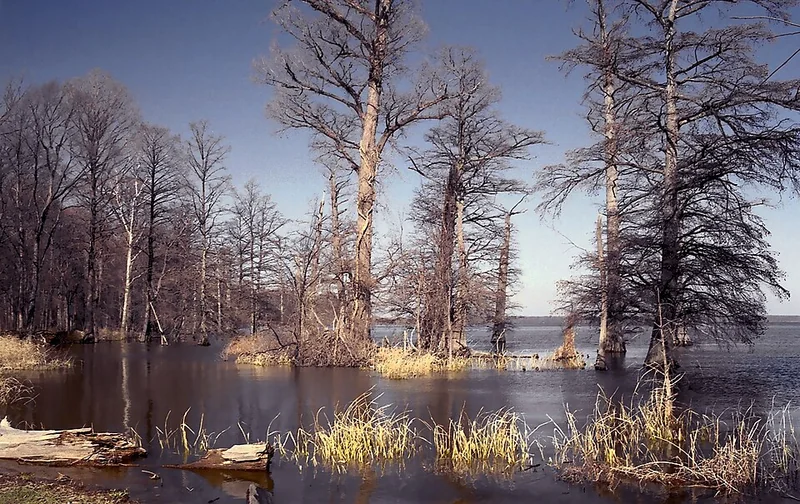
Lake County · Tiptonville
Reelfoot Lake was created by the New Madrid earthquakes of 1811–1812 — the largest earthquake series in recorded North American history — when 5,000 acres of flat woodland subsided and the Mississippi River briefly flowed backward to fill the depression. The resulting lake is shallow (5-foot average depth) and densely forested with bald cypress trees rising from the water. Bald eagles winter here from December through February, with counts regularly exceeding 100 birds. The park is free; guided eagle and cypress tours from the visitor center are available for a small fee in winter.
Watch on YouTube · View on Google Maps
Savage Gulf State Natural Area Worth the detour
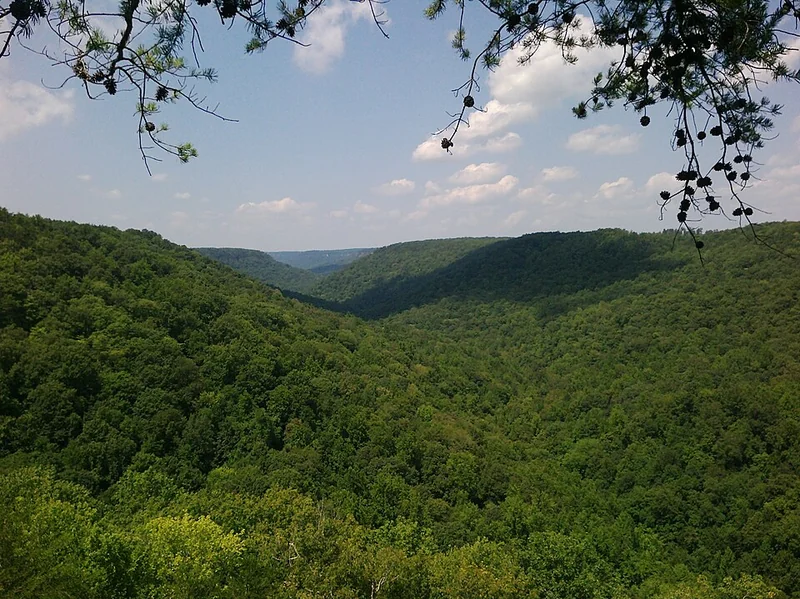
Grundy County · Tracy City
Savage Gulf is a 15,000-acre gorge system on the Cumberland Plateau — three parallel canyons (Savage, Collins, and Big Creek) with 50-mile views from the rim and old-growth hemlock at the bottom. The three gorges converge at a single drainage point, creating an unusual braided structure found almost nowhere else in Tennessee. Fifty-five miles of trails cover the area; the Stone Door trailhead is the most dramatic access point, passing through a narrow slot in the cliff face. No admission fee; the trailhead parking lot fills on fall weekends.
Watch on YouTube · View on Google Maps
History
Three of Tennessee's best history sites are completely free: a Civil War battlefield covering 3,600 acres, a state museum with 60,000 square feet of permanent exhibits, and a Cherokee ancestral site that records the end of a civilization.
Shiloh National Military Park Must-see
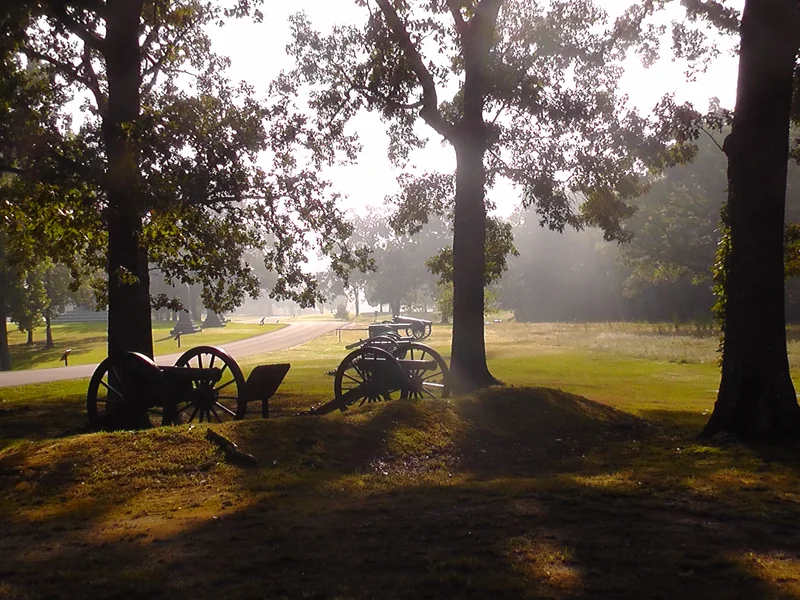
Hardin County · Savannah
The Battle of Shiloh (April 6–7, 1862) produced 23,746 casualties in two days — more than all previous American wars combined. The park preserves 3,600 acres of the original battlefield in Hardin County, including the Hornet's Nest position where the Union line held for six hours on day one, Bloody Pond where wounded soldiers died reaching water, and the Sunken Road. 155 monuments and markers and a self-guided driving tour audio file cover the two-day battle in sequence. No admission fee; the visitor center has a scale model of the battlefield and a 25-minute film.
Watch on YouTube · View on Google Maps
Tennessee State Museum Worth the detour
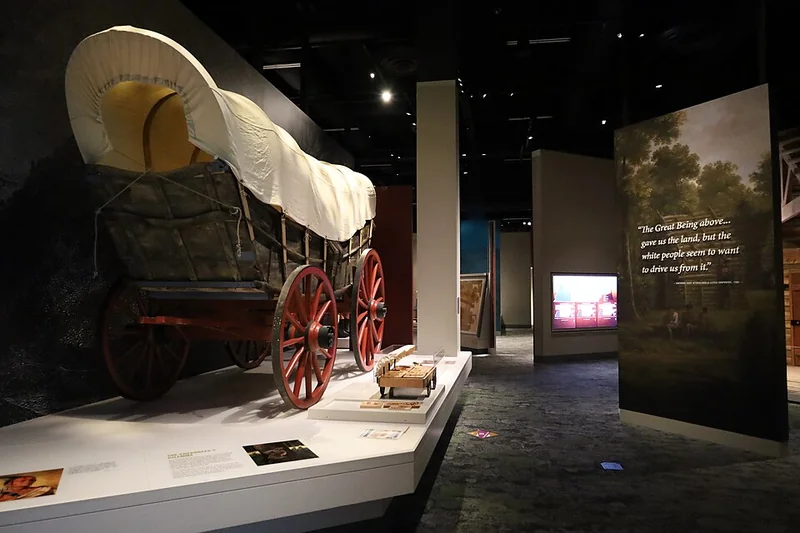
Davidson County · Nashville
The Tennessee State Museum opened a new facility at 1000 Rosa L. Parks Blvd in Nashville in 2019 — 137,000 square feet total, with 60,000 square feet of gallery space. Permanent exhibitions cover Tennessee from prehistoric times through the 20th century: Native American artifacts from Pinson Mounds and Hiwassee Island, Civil War battle flags and uniforms (including the flag of the 1st Tennessee Infantry), and a full-scale moonshiner's still from the Prohibition era. Admission is free; open Tuesday through Sunday.
Watch on YouTube · View on Google Maps
Red Clay State Historic Park (Last Cherokee Council Grounds) Worth the detour
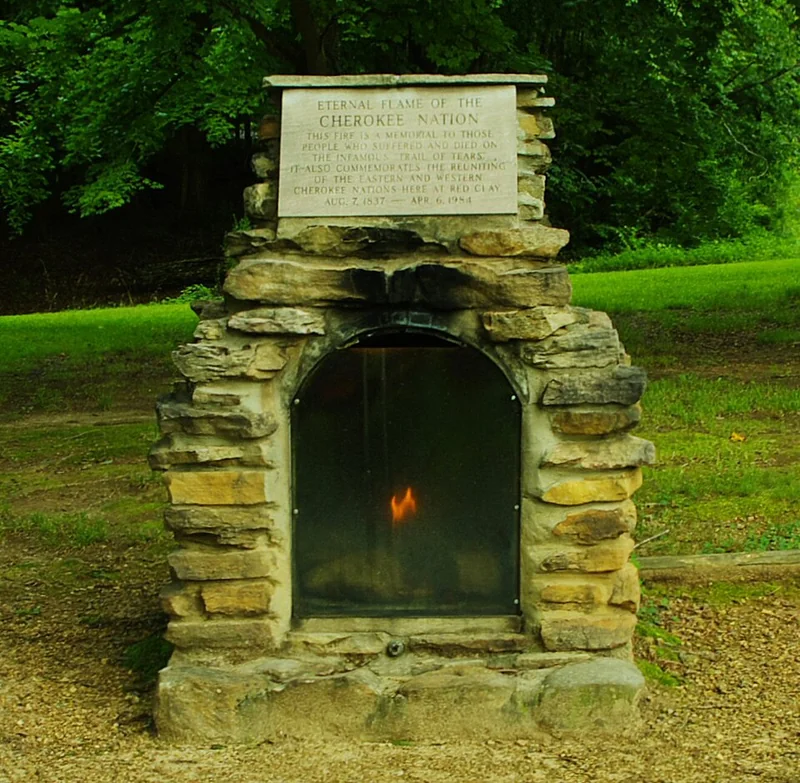
Bradley County · Cleveland
Red Clay was the site of the last Cherokee National Council gatherings (1832–1838) — 11 councils held here in the years before the Trail of Tears forcibly removed the Cherokee nation to Oklahoma. The park preserves the council grounds, a reconstructed Cherokee farmstead, and the Blue Hole, a natural spring that provided water during the councils and remains the park's visual centerpiece. An interpretive museum covers the councils and the removal. No admission; the park is near the Georgia border in Bradley County, about 30 minutes south of Chattanooga.
Watch on YouTube · View on Google Maps
Old Stone Fort State Archaeological Park Worth the detour
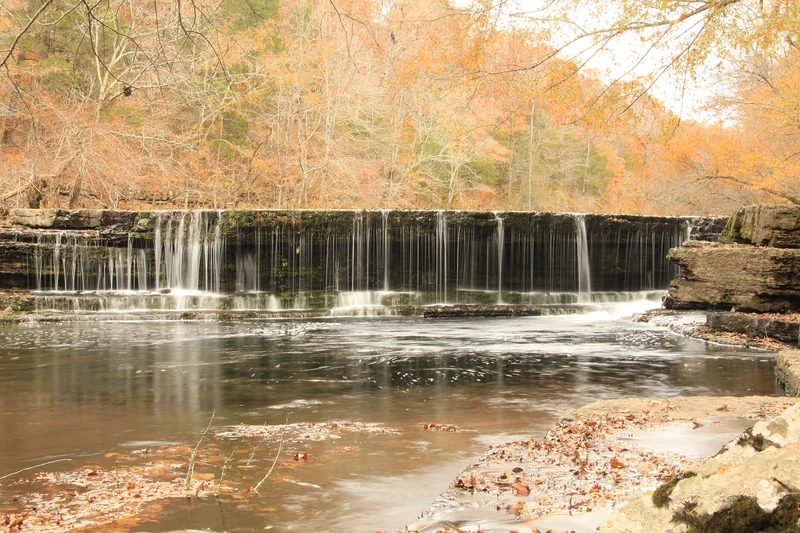
Coffee County · Manchester
Old Stone Fort is a 2,000-year-old Native American ceremonial enclosure built between 1 and 500 AD on a bluff above the confluence of two rivers in Coffee County. The walls — constructed of stone, dirt, and clay — stretch 1.5 miles around a 50-acre plateau. Early European settlers believed it was a fort; it's a Middle Woodland Period ceremonial site whose specific purpose remains unknown. A 1.5-mile trail follows the entire perimeter wall. No admission fee; the site is 65 miles southeast of Nashville near Manchester.
Watch on YouTube · View on Google Maps
USA Travel Planner — Google Sheets
One purchase. Every US state. Forever.
A pre-filled travel dashboard for every US state — we are actively building them out.
- 75+ curated attractions — pre-researched for you
- Built-in budget tracker (countdown, expenses, remaining)
- Step-by-step planning tabs
- Buy once — get all future states free as they launch
City Walks
Four Tennessee cities have walkable districts where the experience — live music, street life, and atmosphere — costs nothing to enjoy.
Nashville's Lower Broadway (Honky Tonk Highway) Must-see
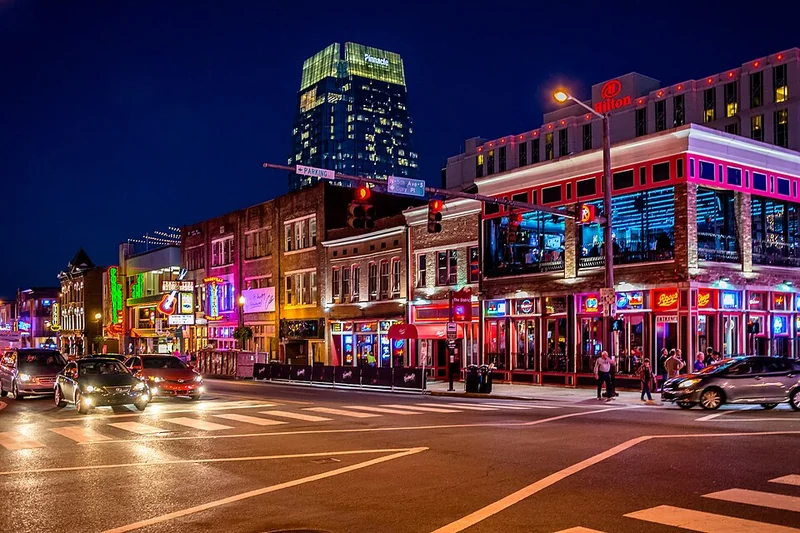
Davidson County · Nashville
Lower Broadway is a four-block strip of bars, boot shops, and live music venues between 1st and 5th Avenues in downtown Nashville. No bar charges a cover; live country bands play from noon to 3 AM seven days a week. Tootsie's Orchid Lounge (open since 1960, alley entrance behind the Ryman) and Robert's Western World are the most historically significant venues on the strip. Arrive before 7 PM on weekends to move freely — it gets genuinely packed after dark. Drinks and food cost money; the music is free.
Watch on YouTube · View on Google Maps
Beale Street Must-see
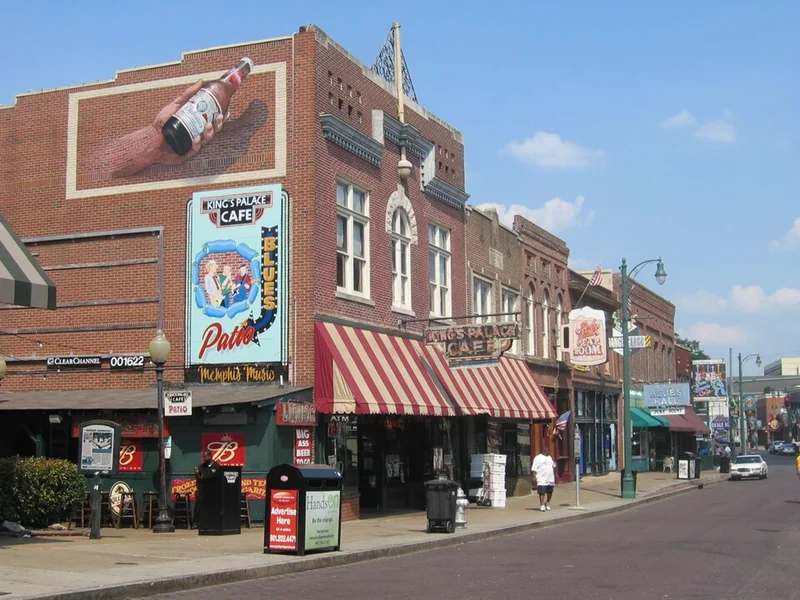
Shelby County · Memphis
Beale Street is designated by Congress as the Home of the Blues — W.C. Handy published the first written blues music here in 1912. The entertainment district runs three blocks through downtown Memphis; every bar is free to enter and live blues, soul, and rock bands play from noon through last call. The adjacent Mississippi Riverfront is a free promenade with views of the river and the Hernando de Soto Bridge stretching into Arkansas.
Watch on YouTube · View on Google Maps
Gatlinburg Strip Must-see

Sevier County · Gatlinburg
The Gatlinburg Strip is the mile-long main street running from the town's north traffic lights to the Great Smoky Mountains National Park entrance at the south. The street is free to walk; the Ole Smoky Moonshine tasting room at the south end offers free tastings, and the national park entrance — where the town simply ends and the wilderness begins — is free. Most visitors spend 2–3 hours on the Strip before heading into the park or toward Pigeon Forge.
Watch on YouTube · View on Google Maps
Market Square (Knoxville Entertainment District) Worth the detour
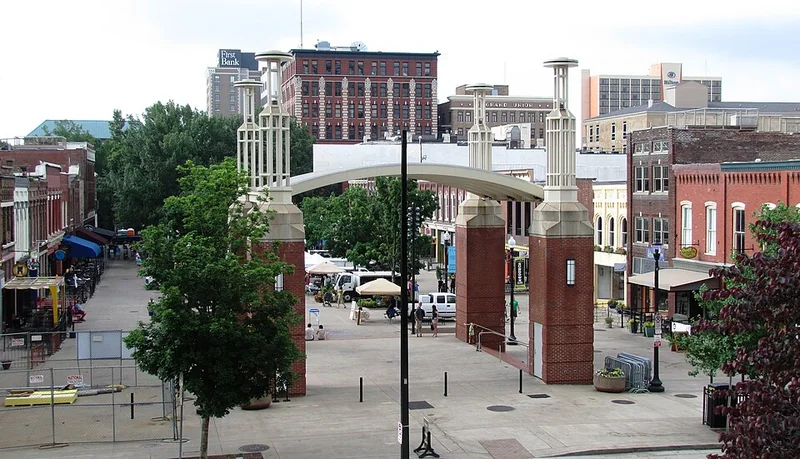
Knox County · Knoxville
Market Square is a 200-year-old public square in downtown Knoxville surrounded by 19th-century commercial buildings now housing restaurants, bars, and shops. Free outdoor concerts run on the square from spring through fall; the World's Fair Park, three blocks away, holds the Sunsphere and a free outdoor green space from the 1982 World's Fair. The Old City neighborhood adjacent to Market Square has Knoxville's densest concentration of bars and nightlife. No admission; the square is at the center of the Knoxville Streetcar Historic District.
Watch on YouTube · View on Google Maps
Free Tennessee Originals
Two Tennessee experiences that are either fully free or have a significant free component — and exist nowhere else in the country.
Peabody Hotel Duck March (Memphis) Must-see
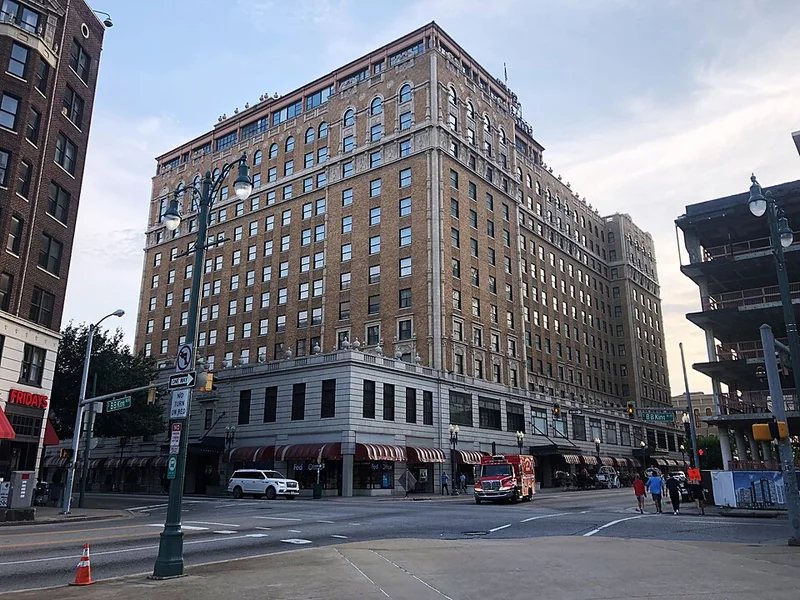
Shelby County · Memphis
The Peabody Hotel duck march has run every day since 1933: at 11 AM, a family of live mallards rides the elevator from the rooftop duck palace to the lobby fountain, marching on a red carpet to John Philip Sousa's "King Cotton"; at 5 PM the procession reverses. The Duckmaster leads the march; the lobby fills with guests and visitors for both events. Watching is free. The Peabody is at 149 Union Avenue in downtown Memphis, three blocks from Beale Street.
Watch on YouTube · View on Google Maps
Memphis Pyramid (Bass Pro Shops Mega-Store) Worth the detour
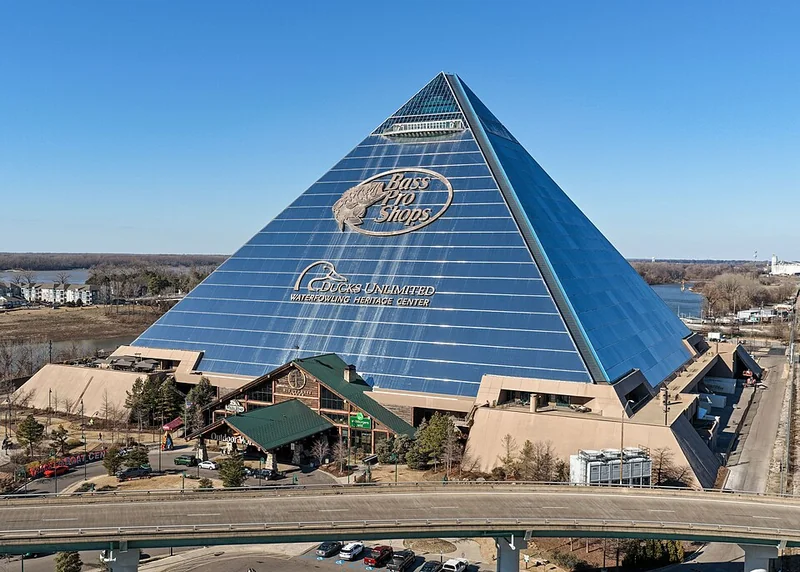
Shelby County · Memphis
The 321-foot Memphis Pyramid — the third-largest pyramid in the world by volume — sat vacant for a decade before Bass Pro Shops converted it into a 535,000-square-foot megastore in 2015. Inside: a 100-room hotel, a bowling alley, an archery range, a cypress swamp with live alligators, and a freestanding indoor forest. Entry to the store is free; the rooftop observation deck charges about $10 for the elevator ride to the apex. On the north riverfront, 5 minutes from Beale Street.
Watch on YouTube · View on Google Maps
Planning Notes
Park reservations and seasonal closures: Great Smoky Mountains requires parking reservations at Laurel Falls, Alum Cave, and Rainbow Falls trailheads from May through October — book at recreation.gov. Clingmans Dome Road closes December through March. Reelfoot Lake is best December–February for eagle watching. Savage Gulf trailhead parking fills on October weekends — arrive before 9 AM.
Plan your visit: Explore city guides for every destination in this article: Gatlinburg & Pigeon Forge, Nashville, Memphis.